When people think about real estate investment, the first things that often come to mind are land, houses, apartments and commercial buildings.
But what if the land you invest in could also support an agricultural business?
This is where agro-real estate comes into the conversation.
Agro-real estate combines land ownership with agricultural use, creating opportunities for investors interested in productive land, farming, plantation development and long-term agricultural value. One crop attracting attention in this space is oil palm.
For investors looking beyond conventional residential property, oil palm plantations may offer an opportunity to participate in an industry that supplies raw materials for food, personal care products and other everyday goods.
However, the important question is not simply whether oil palm is profitable. It is whether the particular investment opportunity is properly structured, independently verifiable and suitable for your financial goals.
Let’s explore what you need to know.
What Is Agro-Real Estate?
Agro-real estate refers broadly to land and property investments connected to agricultural production and related activities.
Unlike conventional real estate, where returns may come from rent, resale or property development, agricultural land may generate value through a combination of land ownership, crop production, agricultural operations and the eventual sale of produce.
Examples include:
- Oil palm plantations.
- Cashew and cocoa farms.
- Agricultural land leased to farmers.
- Commercial crop farms.
- Agro-processing facilities and agricultural storage properties.
The investment structure matters. Purchasing agricultural land directly is not the same as investing in a managed plantation, joining an agricultural investment scheme or funding a farming business.
Before committing money, investors should understand exactly what they are purchasing, what rights they receive and who is responsible for operating the agricultural venture.
Why Is Oil Palm Attracting Investment Interest in Nigeria?
Oil palm is an established agricultural crop with applications across multiple industries.
Palm oil is used in food production, while palm kernel oil and other palm-derived materials are used in various personal care, household and industrial products.
This range of applications creates demand for oil palm products. Nigeria’s Central Bank has also recognised the crop’s economic significance and supported initiatives aimed at improving domestic production and developing the oil palm value chain.
You can explore the Central Bank of Nigeria’s oil palm development initiative for additional background.
For an investor, the attraction lies in the possibility of combining a land-based asset with agricultural production.
But demand for palm oil does not automatically make every plantation profitable. The economics of a particular investment depend on how efficiently the crop is produced, harvested, processed and sold.
Five Reasons to Consider Oil Palm as a Long-Term Agricultural Investment
1. It combines land with productive potential
Land is a finite resource, and agricultural land can serve a productive purpose when its location, soil, water availability and legal status are suitable.
An oil palm plantation brings together the underlying land and the potential to produce an agricultural commodity.
However, owning land does not automatically mean owning a productive plantation. Investors should verify whether the land is suitable for cultivation, whether the palms have been planted and established, and whether the investment includes legally enforceable rights to the land and its produce.
2. Oil palm is a perennial crop
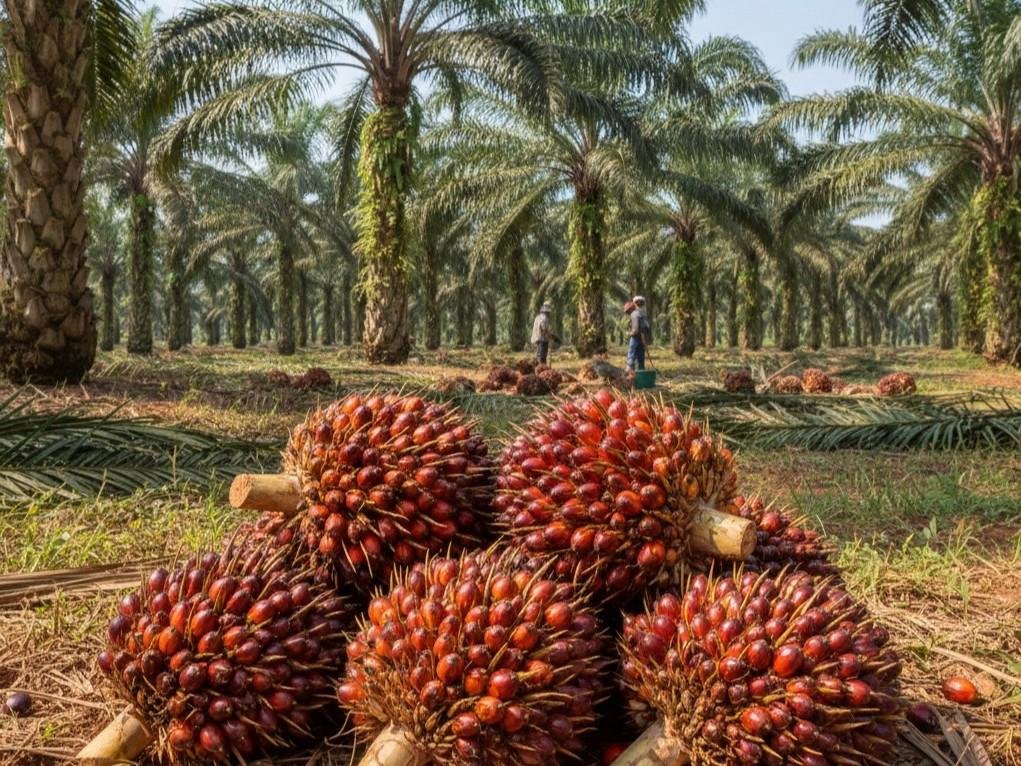
Oil palm is a perennial crop, meaning it can produce fruit over multiple years rather than requiring complete replanting after every harvest.
This makes plantation management a long-term undertaking.
The Food and Agriculture Organization’s case study on Nigeria’s oil palm industry explains that oil palm has a significant establishment period before production begins, with yields developing as the plantation matures.
For investors, this has an important implication: an oil palm investment should be assessed over an appropriate time horizon, not as a scheme promising immediate income from newly planted palms.
Plantation age, variety, agricultural practices, environmental conditions and management all influence productivity.
3. It serves multiple commercial markets
Oil palm produces fresh fruit bunches that can be processed into palm oil and palm kernel products.
These products have various commercial applications, creating opportunities throughout the agricultural value chain.
Nevertheless, the existence of a market is not the same as guaranteed sales at a profitable price. Investors should investigate who will purchase the produce, how it will be processed, the distance to processing facilities, transport costs and the arrangements for selling the harvest.
4. It may diversify an investment portfolio
Investors who already hold residential property, commercial real estate or other financial assets may wish to explore agricultural investments as another asset category.
An oil palm investment may provide exposure to agricultural production rather than relying solely on rental income or property resale.
However, diversification does not eliminate risk. Agricultural investments have their own challenges, including weather, pests, crop disease, operational costs, commodity-price fluctuations and liquidity constraints.
Investors should also consider whether the agricultural investment is sufficiently independent of their existing assets to provide meaningful diversification.
5. It offers opportunities beyond land appreciation
One of the interesting features of agro-real estate is the possibility that the investment may derive value from more than the land itself.
Depending on the ownership and operating structure, value may be connected to the established plantation, agricultural infrastructure, crop production and processing arrangements.
This is different from assuming that land prices will automatically rise.
A well-managed plantation may have productive potential, but the outcome depends on operating performance and the rights held by the investor. Investors should request evidence of actual production, costs, sales and the contractual basis for receiving any income.
How Long Does It Take for Oil Palm to Start Producing?
This is one of the most important questions to ask before investing.
Oil palm is not generally a suitable choice for someone expecting immediate income from newly established palms.
The time to first harvest depends on the planting material, agronomic conditions and management. Commercial harvesting commonly begins around three years after planting under suitable conditions, although timing and output vary. Production generally develops as the plantation matures.
This means investors must understand the difference between:
- Newly planted plantations: These require establishment, maintenance and funding before meaningful production.
- Young producing plantations: These may have started producing fruit but may not yet be at their productive potential.
- Established plantations: These may have more developed production records, although future output still requires verification.
Do not rely solely on the age of a plantation. Ask for evidence of planting dates, palm varieties, survival rates, harvest records and operating expenses.
For an established project, actual records are more useful than broad claims about what a mature plantation might produce.
What Makes an Oil Palm Investment Safe Enough to Consider?
No agricultural investment is completely risk-free. However, proper due diligence can help investors identify avoidable risks before committing their money.
Verify the land title and ownership structure
Establish who legally owns the land and what rights you will receive.
If you are purchasing land, investigate the title, ownership history, survey information, permitted use and any encumbrances. Engage a qualified property lawyer to conduct independent checks.
If you are investing through a plantation operator, clarify whether you will own a specific parcel, hold shares in a company, participate in a managed farming arrangement or receive contractual rights to agricultural proceeds.
These structures are not interchangeable.
Investigate the plantation operator
If another party will manage the plantation, examine its experience and capacity.
Ask about its existing farms, agricultural personnel, maintenance practices, harvesting arrangements, processing partners and financial reporting.
Where the operator claims to have existing production, request records that can be independently checked.
Understand every cost
Your assessment should include all relevant expenses, which may involve land acquisition, seedlings, planting, fertiliser, labour, weed control, pest management, access roads, harvesting, transportation and processing.
Managed investment schemes may also charge management fees, administration fees or other deductions.
Request a complete breakdown of what your contribution covers and identify who bears additional costs if expenses rise.
Demand a clear income model
Ask how income will be generated and distributed.
Will you receive proceeds from produce sales? Is income dependent on the actual harvest? What deductions will be made before distributions? Who bears the consequences of poor yields or falling commodity prices?
Request realistic financial projections supported by documented assumptions.
Be cautious of fixed or guaranteed returns that are not adequately supported by the investment structure and independently verifiable evidence.
Understand how you can exit
Agricultural land and plantation investments can be difficult to sell quickly.
Before investing, find out whether you can transfer your interest, sell your land, withdraw from the scheme or terminate the agreement. Understand the conditions, fees and timelines involved.
Do not invest money you may need urgently unless the investment’s liquidity genuinely meets your needs.
Is Oil Palm Better Than Conventional Real Estate?
Neither option is automatically better. The right choice depends on the investor’s objectives, risk tolerance, financial capacity and investment horizon.
Conventional real estate may generate rental income, provide accommodation or offer resale opportunities. An oil palm investment may provide exposure to agricultural production and commodity markets.
Both can involve significant capital commitments, ongoing costs and risks.
The key difference is the source of potential value. With a residential property, an investor may focus on tenant demand, rental yield, property maintenance and resale value. With oil palm, the investor must also consider agricultural productivity, plantation management, harvest cycles and produce prices.
Some investors may find that agricultural land complements their existing property portfolio. Others may prefer assets that provide more predictable cash flow or are easier to sell.
The decision should be based on a careful comparison of the actual investment terms, rather than the assumption that agriculture or conventional real estate is inherently safer.
Questions to Ask Before Investing in an Oil Palm Plantation
Before committing funds, use this checklist:
- Who legally owns the land, and what title or contractual rights will I receive?
- Is the plantation already established, and can its age and condition be verified?
- What oil palm variety has been planted, and what evidence supports the projected yields?
- Who manages the plantation, and what relevant experience do they have?
- Who will purchase and process the harvested fruit?
- What are the establishment, maintenance, harvesting and management costs?
- How are proceeds calculated, and when could distributions realistically begin?
- What happens if harvests are poor, costs increase or produce prices fall?
- Can I independently inspect the plantation and review its records?
- What are my exit rights if I need to sell or withdraw?
If these questions cannot be answered clearly, take time to investigate before investing.
Final Thoughts: Think Beyond the Land
Agro-real estate offers another way to consider land-based investment, and oil palm is one agricultural crop worth understanding in Nigeria’s investment landscape.
Its perennial nature, commercial applications and connection to agricultural production make it interesting for investors with an appropriate time horizon and a willingness to understand the operating realities.
But a promising industry does not guarantee a profitable investment.
The quality of the land, strength of the ownership rights, capability of the operator, cost of production, market access and clarity of the investment agreement all matter.
At TeefranRealty, we believe property and land investment decisions should be guided by information, due diligence and a clear understanding of what you are buying.
Whether you are considering residential property, agricultural land or an oil palm plantation opportunity, take the time to investigate the facts and make sure the investment aligns with your financial goals.
Interested in exploring land-based and agricultural investment opportunities?
Contact TeefranRealty to discuss your investment objectives and the questions you should ask before making a commitment.
TeefranRealty
We bring your dream home to reality.
Phone/WhatsApp: 08066414992
Website: www.teefranrealty.com
Disclaimer: This article is for general educational purposes and does not constitute financial, legal or agricultural advice. Agricultural investments involve risk, and returns are not guaranteed. Conduct independent due diligence and seek qualified professional advice before investing.